
In emotional event, D.C. jail inmates debate JMU students in courtroom
A powerful moment as men held at the D.C. Central Detention Facility met James Madison University students on the courtroom floor — arguing that reform is not a favor. A rare and moving glimpse of what humanity looks like inside a system built to erase it.
The topic was whether life without parole should be abolished. The inmates said the opportunity gave them purpose.
By Dan Rosenzweig-Ziff Harold Cunningham was locked up more than three decades ago and told he would never see the outside of a prison after committing a string of armed robberies and murders.
On Friday, he stood in a courtroom again. But this wasn’t for a trial, or a sentencing, or a motion, or any of the countless reasons he had previously appeared in court.
Get concise answers to your questions. Try Ask The Post AI. Cunningham and a dozen other D.C. jail inmates had gathered to do something unusual: debate in a federal courtroom against four students from James Madison University.
Cunningham, who had returned to the correctional facility to await a posttrial motion, stood in a blue polo shirt and khaki pants and argued for the abolishment of life sentences without parole.
“You are looking at the representation of everything that this debate is about,” Cunningham said as people in the overflowing courtroom cried. “All Americans should stand for rehabilitation, not retribution.”
U.S. Magistrate Judge Zia M. Faruqui was one of the organizers of the debate. Five ceremonial judges — federal jurists as well as leaders from the Justice Department and Georgetown University’s law school — would decide the winner.
Magistrate Judge Zia M. Faruqui speaks before the debate at the E. Barrett Prettyman Federal Courthouse in Washington. (Craig Hudson for The Washington Post) The 13 members of the jail team began prepping for this day more than two months ago, when they had their first debate class.
“It’s indescribable really — I’ve never had an experience like this,” said Dante Gardner, 34. “Any time I go into a courtroom, it’s to go in front of a judge for a different purpose. This will shed light on an issue I care deeply about.”
Gardner, who faces charges related to a burglary, has been in jail for six months. Before signing up for the class, he felt purposeless inside his cell, he said. Now he had a higher calling.
He hoped to convince not only the debate judges but policymakers and the public that life without parole is immoral and wrong. That it should be abolished. That people like Cunningham deserve a second chance.
He opened the debate with a nine-minute speech, giving a thumbs-up to the crowd in the rows of wooden seats. His stepfather was among those in the audience.
Dante Gardner, a member of the D.C. jail team, opens the debate on the topic of abolishing life without parole. (Craig Hudson for The Washington Post) Gardner argued that life without parole violates human dignity; is cruel and unusual, racist and inequitable; and doesn’t deter crime. He cited research about how the imprisonment and crime rates in the United States compare with those in other countries, and noted how many Black men are behind bars.
“Is this what we really want to be known for as a country?” he asked, speaking at a deliberate pace after stumbling over some words at the start. He finished to applause and high-fives from his fellow inmates, all seated behind him.
Faruqui and coaches started the debate team at the beginning of the year to increase educational opportunities for people held in the D.C. jail. The coaches, onetime debaters themselves, went to the facility to train inmates in a semester-long class that culminated in an April debate at the jail against students from Georgetown University. The teams debated the disenfranchisement of people with felonies. Judges awarded Georgetown the win, 3-2.
This fall, a new class met twice a week to review a 200-page packet of arguments for abolishment of life without parole, researching how opponents might poke holes in their presentations. They also practiced logic-based debate on hot topics such as whether a hot dog is a sandwich. Then they’d work with their unit mates to perfect their assignments.
Six members of the class eventually received speaking roles for the competition.
But coaches and organizers wanted to reimagine the debate. So they asked the jail, U.S. marshals and judges if the next competition could be at the federal courthouse. They agreed.
“When people are incarcerated, they often only come to court for punitive reasons,” said Victoria Sheber, one of the coaches. “We wanted to destigmatize the courtroom.”
Instead of appearing in orange jumpsuits, the debaters wore shirts and khaki pants. The James Madison students came to the stand with laptops and digital timers. The D.C. jail team, lacking the same technology as their counterparts, brought loose papers and handwritten notes.
The JMU students argued that life without parole, or LWOP, should not be abolished, but rather reserved for the most violent offenders who had committed first-degree murder. They claimed that death sentences would increase without that option, and said the most dangerous people should lose their right to be free. The students also said releasing those convicted murderers would traumatize families of the victims.
“Serial killers could be released if LWOP is fully abolished,” said JMU senior Tarang Mishra.
Nikia Cunningham, who is not related to Harold, countered the JMU student’s argument with a statistic. She said 98 percent of those convicted of homicide don’t commit another killing once released. Why should they lose the chance to be free? she asked.
Then she moved to the death penalty argument.
“LWOP is the death penalty in disguise,” she said, adding that having no hope of release is as bad, if not worse, than being executed.
She looked out at the spectators — who had filled every seat in the ceremonial courtroom and packed into an overflow room — and smiled. She returned to her team and was greeted with high-fives.
Nikia Cunningham, Nathaniel Perkins and other members of the D.C. jail team clap during the debate. (Craig Hudson for The Washington Post) The teammates had supported one another for weeks, learning not only how to argue for the abolishment of life without parole but also how to better advocate for themselves in the justice system. Some started to sense they could actually win.
Finally, Harold Cunningham took the stand, wearing a white knitted cap.
“My three decades of incarceration has cost nearly $2 million in your taxpayer dollars,” he said. He noted that he had served an extended time in solitary confinement and entered jail with mental health issues. He couldn’t read or write.
But now, he was arguing that people like him were worth saving. That, when given the chance, they could rehabilitate themselves and mentor people, as he did for younger men in the jail.
The Washington Post had written about him three decades ago, he went on, saying he would never leave jail. He held up a more recent edition of The Post with an article that called him a symbol of rehabilitation.
“The next time I hold this up, I hope I’ll see a picture of my team with a headline that says ‘Life without parole has been abolished,’” he said, as people in the crowd cheered and stood. “I love you all.”
After the arguments were over, the judges deliberated for less than 10 minutes. Some of the coaches for the jail team were already wiping away tears, proud of how their students had performed.
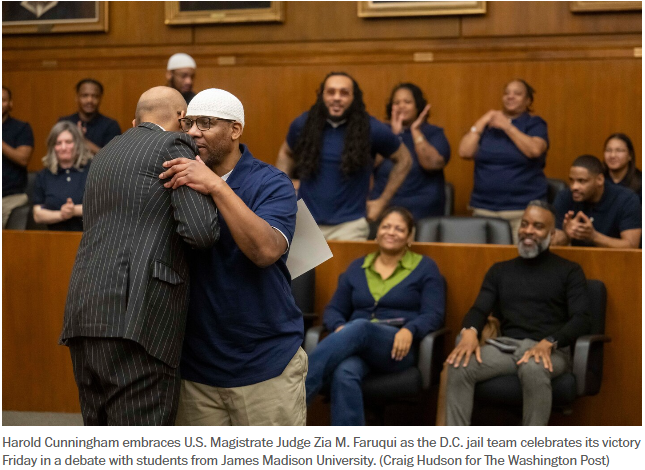
The judges filed back in and announced the winner: the team from the D.C. jail.
Cheers and tears erupted not just from them, but also from their family and friends and coaches around the room.
The judges said Cunningham’s speech was a large part of the victory. He had shown why someone like him deserved a second chance, one of the judges said.
“The best evidence of the affirmative argument is you people right here and what you did today,” said U.S. District Judge Michael Nachmanoff of Virginia.
The D.C. jail team celebrates its victory. (Craig Hudson for The Washington Post) The team from the jail couldn’t stop hugging one other. Their opponents from JMU stood and clapped for them. Relatives snapped photos from across the room as the team members flashed a thumbs-up or a wave. Each winner received a certificate and a photo with each ceremonial judge.
After a joyous two hours, the U.S. marshals led the team members out of the courtroom. They would soon return to the jail.
“The world was watching us today,” said Nathaniel Perkins, a debater from the jail. “I just hope it makes a difference.”